Does Your HVAC Take 16x32x4 Air Filters? How To Check
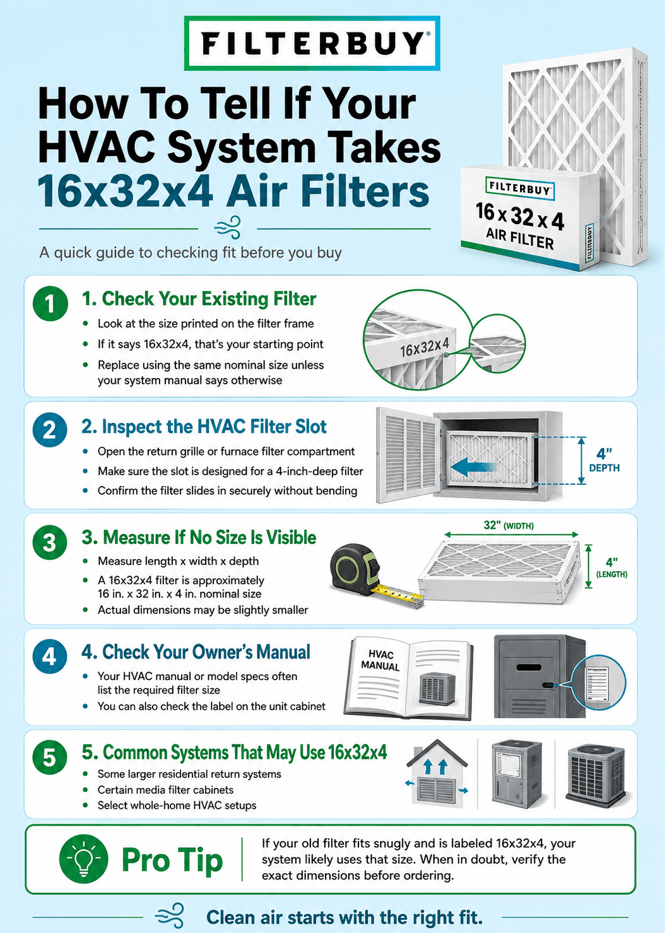
Pull the existing filter and read the frame. A system that takes this size shows the nominal designation 16x32x4 printed in large type, with an actual size near 15.5 by 31.5 by 3.63 inches printed smaller alongside it. If the cabinet is empty, measure the slot opening itself. Order by the nominal number, because manufacturers label and stock filters that way.
TL;DR
Your system takes a 16x32x4 filter if the cabinet label says so, or if the slot measures about 15.5 by 31.5 inches with a depth near 4 inches. Order by the nominal size, 16x32x4, not by what your tape reads. We come at this from the duct-sealing side, where a filter two inches short is often the largest single opening left in an otherwise sealed system.
Key Takeaways
A 16x32x4 filter has a nominal size of 16 by 32 by 4 inches and an actual size of about 15.50 by 31.50 by 3.63 inches.
To turn a tape reading into an orderable size, round each measurement up to the next whole inch. A slot reading 15.5 by 31.5 inches is a 16 by 32 cabinet.
The arrow on the frame points toward the furnace or air handler, in the direction air travels.
The size most often confused with 16x32x4 is 16x30x4, which runs two inches shorter. A filter that short still slides in and still leaves a gap the blower finds.
How Do You Confirm Your System Takes A 16x32x4 Filter?
Check three things in this order: the cabinet label, the old filter frame, and the slot itself. A legible label outranks everything else, because it describes what the housing was built for, while a filter only describes what the last person bought.
Shut off power at the service switch or breaker.
Open the access door and look for a data plate or sticker listing the filter size.
Slide the old filter out and read both numbers on the frame. The large one is nominal; the smaller one is actual.
Measure the slot opening in height and width, then the depth from the door to the back wall.
A slot measuring 15.5 by 31.5 inches with a depth just over 3.5 inches is a 16x32x4 cabinet. This is where people go wrong, because ordering the measured number leaves you short.
We pull filters that do not match their cabinet often enough that we no longer treat the old filter as proof of anything. A previous owner buys from memory, and that number stays for years.
What Are The Actual Dimensions Of A 16x32x4 Filter?
A 16x32x4 filter measures about 15.50 by 31.50 by 3.63 inches. Nominal size is the rounded label used for ordering. Actual size is the finished filter, built slightly under so it slides in without binding.
Filterbuy, a United States manufacturer of pleated MERV-rated HVAC filters that sells more than 600 sizes directly to homeowners, publishes those actual dimensions on the product page for the size 16x32x4 air filters. Canadian readers can order it from the Filterbuy Canadian storefront in Canadian dollars, where the listed dimensions match the U.S. specification.
The mistake we correct most often runs the other way. Someone measures the slot, orders those exact numbers, and receives something smaller still. The convention is universal across brands, which is why filter frames measure smaller than the printed size. Measuring identifies the size. It does not order it.
Which Filter Sizes Get Mistaken For 16x32x4?
Four-inch filters in the 16-inch family share the same 15.50-inch width and differ only in length, so mix-ups are almost always length errors. A filter too wide gets caught at the store. One two inches short slides in cleanly and looks installed.
If your tape reads closer to 29.5 inches, your cabinet was built for the 16x30x4 size instead.
Where Does The Filter Sit, And Which Way Does It Go In?
A four-inch filter sits in a media cabinet, a sheet metal box in the return line where it meets the furnace or air handler. The arrow on the frame points toward that equipment, in the direction air travels. Inside is a pleated air filter, folded to raise surface area without raising the footprint.
The most common wrong turn is hunting behind a hallway return grille for a filter that lives on the equipment. If nothing is behind the grille, the system pulls through a cabinet elsewhere.
A backwards filter still catches dust, which is why the mistake survives. What it loses is capacity. The wire backing belongs on the downstream face, and reversed, it lets pleats pack together as the filter loads, so airflow drops earlier than expected.
Depth deserves the same care. Four-inch and five-inch cabinets look alike from outside, and a four-inch filter slides into a five-inch housing without resistance, leaving an inch of open channel that behaves like an undersized filter. That cabinet sits on the suction side of the blower, which is why filter condition and duct sealing move together.
Why Does The Wrong Filter Size Undo Duct Sealing?
A filter that does not fill its slot creates a bypass, a path letting return air reach the blower without passing through the media. ASHRAE, which writes the test standard behind MERV, states that air traveling around a filter never gets cleaned, so a bypassing filter can perform like a lower rating than you paid for. For a slot that runs slightly loose, ASHRAE suggests tape to hold the filter forward against the sealing surface.
The EPA tells homeowners to make sure a filter fits snugly so air does not leak around it, and warns against bending or crushing one to fit. NIOSH tells building operators the same thing: verify filter sizing and inspect housings so air flows through rather than around.
You can usually read a bypass off the parts rather than a gauge. When we pull a filter that has been leaking around its edge, the media face still looks reasonably clean while the blower wheel and coil carry a felted grey layer. That pairing is the tell. A filter that still looks good after ninety days in a system running daily is often evidence that most of the air went around it.
A gapping filter slot belongs on the same repair list as an unsealed plenum seam and is usually cheaper to correct. If the system has not been tested, start by learning which symptoms point to duct leaks. The EPA notes manufacturers typically recommend replacement every 60 to 90 days.
What If Your Slot Is One Inch Deep Instead?
Some homeowners open the door expecting a four-inch cabinet and find a one-inch rack. A 16x30x1 filter measures roughly 15.75 by 29.75 by 0.75 inches, against 15.50 by 31.50 by 3.63 for a 16x32x4. Neither fits in the other. If that is what you have, the Filterbuy 16x30x1 is carried at Amazon, Walmart, Home Depot, and Target. Change a one-inch filter far more often, since it holds much less dust.
"Homeowners call me about a back bedroom that will not hold temperature, so we run a duct leakage test. More often than people expect, the largest single opening we find is not a duct joint. It is the filter slot, holding a filter two inches short of the cabinet it was built for. The filter looks clean, and the blower wheel is filthy. Once you have seen that pairing a few times, you stop reading a clean filter as good news." - Teddy Du, air-duct-sealing-service.com
Essential Resources
Guide to Air Cleaners in the Home · U.S. Environmental Protection Agency. Sets the snug-fit standard, the MERV 13 recommendation, and the replacement interval.
Improving Air Cleanliness · National Institute for Occupational Safety and Health. Ventilation guidance on verifying filter sizing and inspecting housings and racks.
Air Cleaning · American Lung Association. Where filters sit in a residential return and how to judge when one is loaded.
Control Indoor Allergens to Improve Indoor Air Quality · Asthma and Allergy Foundation of America. Source-control steps for dust mites, dander, and mold that filtration supports.
Supporting Statistics
Leaky ducts can reduce heating and cooling system efficiency by as much as 20 percent. A filter slot that does not seal adds to that.
Source: ENERGY STAR, Benefits of Duct Sealing
Two-thirds of U.S. households use central air conditioning or a central heat pump as their main cooling equipment. Those systems move all return air through a single filter, so a single gap matters.
Source: U.S. Energy Information Administration, 2020 RECS
Modeling across 11 filter classifications and 22 U.S. cities found that filter efficiency and ventilation system characteristics, rather than geography, drove most of the differences in health outcomes associated with residential filtration. Equipment and installation outweigh location.
Source: National Library of Medicine, PMC4515730
Final Thoughts
Size decides where the filter goes. MERV decides what it catches. A four-inch cabinet tolerates a higher rating than a one-inch slot because the deeper pleat pack spreads airflow across more media. If you are weighing the top of the scale, compare MERV 14 against true HEPA. For households focused on airborne illness, there is guidance on virus-sized particles, on respiratory protection at home, and on the rating scale itself. None of it matters if the filter does not fill its slot.
Frequently Asked Questions
Q: Can I Use A 16x30x4 Filter If My System Takes 16x32x4?
A: No. It measures about two inches shorter than the slot, leaving an open channel along one edge for return air to bypass the media. Order the nominal size the cabinet was built for.
Q: Which Direction Should The Arrow On The Filter Point?
A: Toward the furnace or air handler, following the direction air travels. A backwards filter still catches dust but loses capacity, because the pleat support ends up on the intake side.
Q: What If The Correct Size Is Out Of Stock This Week?
A: Leave the old filter in rather than dropping in a smaller one. This runs against the usual advice, but a filter a few weeks overdue still treats the air reaching it, while a filter two inches short sends part of that air around the media entirely.
Q: My Filter Is The Right Size But Rattles In The Slot. Is That Normal?
A: A small clearance is designed in so the filter slides without bending. Rattling or visible daylight along an edge is different, and taping the filter forward against the sealing surface closes the path around the frame.
Check Your Filter Slot This Week
The filter aisle has trained people to solve the wrong problem. Homeowners upgrade a rating every season and never check whether the filter fills its slot. We would take a correctly sized MERV 8 in a sealed cabinet over a MERV 13 floating in a loose one.
Shut off the air handler, open the cabinet, and measure the slot. Write the nominal size on tape inside the door so the next person orders correctly. A damaged or out-of-square cabinet is a job for a technician, and South Florida readers can start with installation help near Delray Beach or maintenance around Jupiter.
Related Sizes And Further Reading
None of these are 16x32x4, and none of their dimensions apply to that cabinet, but the measuring method transfers to any size: choosing a filter for a home system, replacement timing and technique, compact square sizes, 8x30x2, 10x15x4, 8x24x4, and 12x24x2.
Learn more about HVAC Care from one of our HVAC solutions branches…
Filterbuy HVAC Solutions - Miami FL - Air Conditioning Service
1300 S Miami Ave Apt 4806 Miami FL 33130
(305) 306-5027
https://maps.app.goo.gl/Ci1vrL596LhvXKU79